
Egyptian Combat History: Weapons, Warriors, and Wars

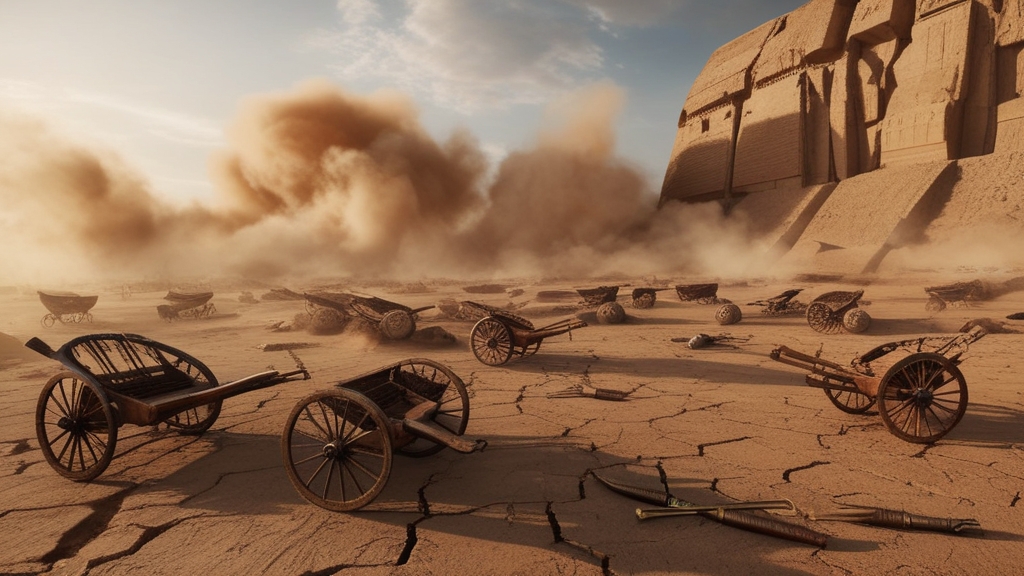
Here's a question most people never think to ask: why did one of the ancient world's most sophisticated civilizations spend so much of its energy learning how to kill? The Nile Valley gave Egypt fertile soil, predictable floods, and natural desert barriers on three sides. It should have been a paradise with no need for armies. Yet Egyptian combat history spans thousands of years of organized, sophisticated, and often brutal warfare — from Predynastic raiding parties to tank battles in the Western Desert. The answer is wrapped up in everything from geography to theology and it's worth unpacking carefully.
- When the Nile Ran Red: A Brief History of Egyptian Warfare
- The Arsenal of the Pharaohs: Ancient Egyptian Weapons Up Close
- Shields, Chariots, and Armor: How Egypt Protected Its Warriors
- Who Fought for the Pharaoh: Egyptian Military Organization and Ranks
- Doctrine on the Battlefield: Strategy, Tactics, and Naval Warfare
- Egypt at War Beyond the Ancient World: Egyptian Combat History Through the Centuries
- Unarmed Combat and Martial Traditions in Ancient Egypt
- What Egyptian Combat History Still Teaches Us
- Frequently Asked Questions
-
FAQ
- What weapons did ancient Egyptian soldiers use in battle?
- How was the ancient Egyptian army organized and ranked?
- What role did Egypt play in World War II combat?
- Did ancient Egyptians practice any form of unarmed combat or martial arts?
- How did the Hyksos invasion change Egyptian military technology?
- What was daily life like for an ancient Egyptian soldier on campaign?
When the Nile Ran Red: A Brief History of Egyptian Warfare
Picture this: it's 1274 BCE, near the city of Kadesh on the Orontes River in modern Syria. Ramesses II has just led his Division of Amun into what he believes is an undefended approach — and walked straight into a Hittite ambush. Two thousand Hittite chariots pour out from behind the city and slam into the Egyptian column. The Division of Ra, marching behind, disintegrates. Ramesses, by his own account, personally rallied his bodyguard and charged the Hittite line six times before reinforcements arrived. Whether you believe every detail of that account or not, the Battle of Kadesh is the oldest recorded military engagement for which we have detailed tactical descriptions from both sides. It's a fitting entry point into the full arc of Egyptian military history.
From Predynastic Skirmishes to Empire-Scale Campaigns
Long before the pharaohs, Predynastic Egyptians — roughly 5500 to 3100 BCE — were already using flint-tipped arrows, maces, and ivory-handled daggers in inter-tribal conflict. The unification of Upper and Lower Egypt around 3100 BCE was itself a military event: the Narmer Palette, one of the earliest historical artifacts we have, depicts a king smashing an enemy's skull with a mace. From that moment forward, Egyptian military history tracks closely with the ambitions and anxieties of whoever sat on the throne.
The Old Kingdom (c. 2686–2181 BCE) relied on conscripted levies and punitive expeditions into Nubia and the Sinai. The Middle Kingdom (c. 2055–1650 BCE) brought more systematic military organization and the construction of massive mud-brick fortresses along the Nubian frontier. The New Kingdom (c. 1550–1070 BCE) is the period most people picture when they imagine Egyptian warfare: professional armies, chariot corps, campaigns deep into the Levant, and the confrontations with the Hittites and Sea Peoples that tested the empire to its limits.
How Geography Shaped Egypt's Military Mindset
Egypt's geography is a double-edged blade. The Eastern and Western Deserts provided natural buffers — an invader crossing either one without local knowledge would likely die of thirst before reaching the Nile. The Mediterranean coast and the Sinai Peninsula, though, were perennial pressure points. Every major invasion of Egypt in antiquity came through the northeastern corridor: the Hyksos, the Assyrians, the Persians, Alexander, and eventually the Romans all entered from that direction.
This geography pushed Egyptian military thinking toward border control and rapid-response mobility rather than deep defensive lines. Fortress chains in Nubia and the Sinai were designed as early-warning systems as much as barriers. When a threat materialized, the Egyptian army was expected to move fast and hit hard — a doctrine that explains the central role of the chariot in the New Kingdom military.
Key Conflicts That Defined Egyptian Combat History
Several engagements stand out across the full timeline:
- The Hyksos Wars (c. 1650–1550 BCE) — The Hyksos occupation of the Delta introduced Egypt to the composite bow, the horse-drawn chariot, and bronze weapons. The campaigns of Seqenenre Tao, Kamose, and Ahmose I to expel them were the crucible of the New Kingdom army.
- The Battle of Megiddo (c. 1457 BCE) — Thutmose III defeated a Canaanite coalition at Megiddo, demonstrating Egyptian combined-arms tactics at their peak.
- The Battle of Kadesh (1274 BCE) — A tactical draw that became a diplomatic landmark: the resulting Egyptian-Hittite peace treaty is the oldest surviving international treaty.
- The Sea Peoples Campaigns (c. 1180–1170 BCE) — Ramesses III repelled multiple waves of Sea Peoples invasions, including a significant naval engagement.
- The Persian Conquests (525 BCE, 343 BCE) — Egypt fell twice to Achaemenid Persia, marking the end of native pharaonic military power.
The Arsenal of the Pharaohs: Ancient Egyptian Weapons Up Close
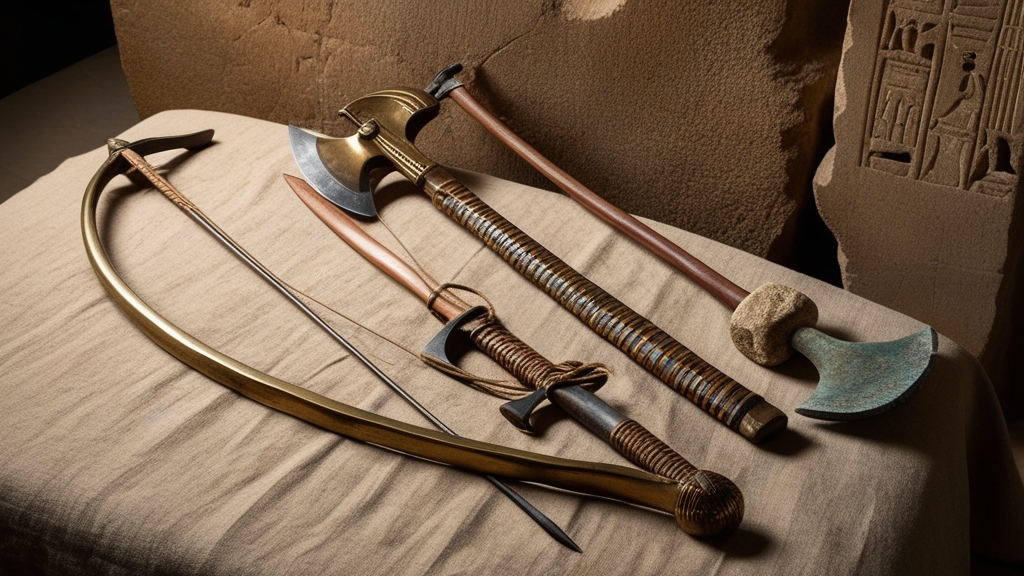
Ancient Egyptian weapons weren't primitive. They were purpose-engineered tools, refined over centuries of actual combat experience. What's more interesting than their appearance is how they were used — the body mechanics, the formation logic, the tactical context that made each weapon worth carrying into a fight.
Bows, Arrows, and the Composite Revolution
The composite bow is arguably the most consequential weapon in ancient Egyptian combat history. Before the Hyksos arrived, Egypt used a simple self-bow — a single piece of wood, effective but limited in range and draw weight. The composite bow, adopted after the Hyksos wars, was a laminated construction of wood, horn, and sinew bonded together. It stored far more energy per unit of draw length, which meant greater range and penetrating power from a chariot platform moving at speed. Pull one of these at full draw and you feel the difference immediately — it loads like a spring, not a stick.
Nubian mercenaries — the famous Medjay — were prized precisely because of their archery skill. Egyptian sources consistently describe them as superior archers and they formed both elite infantry and police units throughout the New Kingdom. An Egyptian chariot archer, standing in a light wicker car pulled by two horses, could loose arrows at a gallop and be out of effective spear range before an infantryman could close the distance.
Spears, Maces, and the Weapons Every Foot Soldier Carried
The average Egyptian infantryman carried a short thrusting spear — a hardwood shaft tipped with a bronze or flint point — and either a mace or a hand axe as a secondary weapon. The mace is Egypt's oldest prestige weapon: the Narmer Palette shows it as the instrument of royal authority and it remained in use as a ceremonial object long after bronze axes had made it tactically obsolete against armored opponents.
Battle axes with fenestrated (perforated) bronze heads were lighter and more effective against leather-and-linen armor than solid maces. Foot soldiers carried them with a round or rectangular shield in the off-hand, fighting in loose formations rather than the tight phalanx structures of later Greek warfare.
Daggers, Khepesh Swords, and the Blades That Crossed Cultures
The khepesh — sometimes transliterated as khopesh — is the curved sickle-sword most closely associated with Egyptian iconography. What most sources skip is that it wasn't originally Egyptian. The khepesh derived from a Canaanite and Mesopotamian weapon form, the sickle sword, which appeared in the Levant before Egypt adopted and adapted it during the New Kingdom. Egyptian craftsmen modified the proportions, typically producing a bronze blade roughly 50–60 cm long with a hook-shaped outer edge used for slashing and trapping an opponent's weapon.
Daggers were personal sidearms for both officers and elite infantry. Tutankhamun's famous iron dagger — likely of Hittite or Anatolian origin given that iron was still rare in Egypt at the time — illustrates how high-status blades moved between cultures through gift exchange and conquest.
| Weapon | Primary Material | Primary Role | Tactical Context |
|---|---|---|---|
| Composite Bow | Wood, horn, sinew | Ranged fire | Chariot platform, massed infantry |
| Thrusting Spear | Wood, bronze tip | Close infantry | Loose formation fighting |
| Battle Axe | Bronze head, wood | Cutting/chopping | Anti-armor, close combat |
| Mace | Stone or bronze head | Crushing | Ceremonial, early warfare |
| Khepesh | Bronze | Slashing, hooking | Officer weapon, elite infantry |
| Dagger | Bronze or iron | Personal defense | All ranks, sidearm |
Shields, Chariots, and Armor: How Egypt Protected Its Warriors
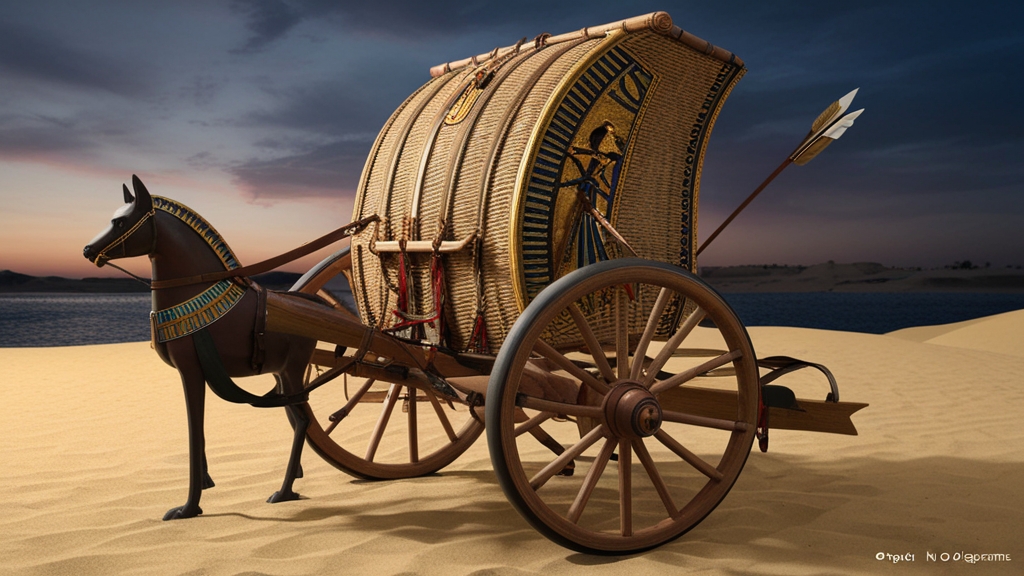
Egyptian military doctrine leaned heavily into offensive mobility. Protection mattered but it was never allowed to slow things down — a philosophy that shaped every aspect of how Egyptian warriors equipped themselves.
Shield Construction and the Reality of Egyptian Body Armor
Egyptian body armor was minimal by Near Eastern standards. Most infantry relied on a large rectangular or round-topped shield made from cowhide stretched over a wooden frame — effective against arrows and glancing blows but offering no protection to the legs or sides. Officers sometimes wore scale armor (spsr), a tunic of overlapping bronze or leather scales sewn onto a linen backing. It stopped a direct arrow strike but was heavy and punishing in the Egyptian climate.
The choice to minimize armor wasn't ignorance — it was a calculated trade-off. Light infantry moved faster, tired less quickly in desert heat, and covered more ground per day on campaign. Egyptian logistics were already stretched thin on Levantine campaigns hundreds of kilometers from the Nile. You don't win a race in a coat of mail.
The War Chariot: Egypt's Most Decisive Military Import
The war chariot entered Egyptian military history through the back door — literally. The Hyksos, a Semitic-speaking people who controlled the Nile Delta from roughly 1650 to 1550 BCE, brought horses and chariots with them. When the Theban kings expelled the Hyksos, they kept the technology and built an entire branch of the military around it.
The Egyptian chariot was lighter than its Hittite counterpart — the axle was positioned at the rear of the car rather than the middle, improving stability at speed. A crew of two operated each vehicle: a driver (kedjen) and an archer. In battle, chariot squadrons would sweep along the enemy line, loosing arrows at close range, then wheel away before infantry could engage them. Harassment and shock combined — the ancient world's closest equivalent to a strafing run.
At Kadesh, Ramesses II reportedly had around 2,000 chariots in his force. The Hittites fielded a similar number but heavier vehicles carrying three men each — driver, archer, and shield-bearer — which made them more effective in close melee but slower to maneuver.
Siege Equipment and Fortified Positions Along the Borders
Egypt built an extensive chain of fortresses along its Nubian frontier during the Middle Kingdom — the fortresses at Buhen and Semna are the best-documented examples. These weren't passive defensive positions. They were forward logistics bases, garrisoned year-round, with granaries, workshops, and river docks that allowed rapid deployment of forces up or down the Nile.
For offensive sieges, Egyptian forces used scaling ladders, battering rams mounted on wheeled frames, and occasional wall-undermining. They weren't as sophisticated in siege craft as the Assyrians would later become but they were competent. The psychological dimension of siege warfare — starving out a garrison, cutting the water supply — was well understood and deliberately applied.
Who Fought for the Pharaoh: Egyptian Military Organization and Ranks
The New Kingdom Egyptian army was structured, paid, and supplied in ways that would be recognizable to any modern logistician. Three thousand years before staff colleges existed, Egypt was already solving the same problems: how do you move 20,000 men through desert terrain and keep them fed, armed, and willing to fight?
The Structure of the Egyptian Army: Divisions, Units, and Command
By the time of Ramesses II, the Egyptian army was organized into divisions (mesha), each nominally 5,000 men strong and named after a major deity. At Kadesh, Ramesses commanded four divisions: Amun, Ra, Ptah, and Set. Each division included both chariotry and infantry, operating as a combined-arms unit capable of independent action.
Below the division level, units were organized roughly as follows:
- Company (sa): approximately 200 men
- Platoon (djet): approximately 50 men
- Squad (10-man unit): the basic tactical element
Command ran from the pharaoh at the top — supreme commander and, in official ideology, a god incarnate fighting alongside his troops — down through generals (imy-r mesha), standard-bearers, and squad leaders.
Professional Soldiers vs. Conscripts and Foreign Mercenaries
The New Kingdom army blended three distinct types of fighters. Professional soldiers (nfrw) formed the core: career warriors who trained continuously, received land grants and rations as pay, and could rise through the ranks based on demonstrated valor. Conscripts were levied from the general population for specific campaigns — one ancient Egyptian text suggests a ratio of roughly one conscript per hundred civilians, though this figure shouldn't be taken as precise policy.
Foreign mercenaries were the wild card. Nubian Medjay archers served as both frontline troops and internal security forces. The Sherden — likely from the Aegean or Anatolian coast, and among the same Sea Peoples groups Egypt later fought — appear in Egyptian records as mercenaries fighting for Ramesses at Kadesh, wearing their distinctive horned helmets. Egypt's willingness to put yesterday's enemies in its elite units was both pragmatic and a mark of real military sophistication.
Daily Life of an Ancient Egyptian Soldier
Campaign life was hard. A soldier on the march in the Levant carried his weapons, a water skin, rations of bread and dried fish, and whatever personal kit he could manage. Egyptian texts from the New Kingdom — including the satirical Papyrus Anastasi I — describe the miseries of the infantry soldier with unflinching specificity: blisters, bad water, ambushes in mountain passes, and the constant threat of disease.
Successful campaigns, though, meant plunder. Soldiers received shares of captured cattle, slaves, and precious metals. Officers who distinguished themselves in battle could receive the Gold of Valor (nbw n qni) — gold fly-shaped pendants awarded by the pharaoh personally. Several sets of these awards have been found in archaeological contexts, confirming that individual battlefield recognition was a real institution, not just propaganda.
Egyptian military thinking favored speed, indirect approach, and psychological pressure over grinding attritional warfare — a preference grounded in both geography and resource constraints.
Chariotry and Infantry: How Egypt Combined Arms
The standard Egyptian battle plan used chariot squadrons to disrupt and disorder the enemy line while infantry moved up to exploit the gaps. Archers — both mounted and on foot — suppressed enemy movement at range. Close-combat infantry then closed in with spears and axes. It wasn't elegant but it was effective against the coalition armies of Canaan and Nubia that Egypt most frequently faced.
Where Egyptian commanders truly excelled was indirect approach: avoiding frontal assaults on prepared positions, using desert routes to achieve surprise, and cutting supply lines before engaging. The research on Egyptian military history consistently shows that Egyptians favored rapid movement and oblique engagement as core strategic principles — and this pattern appears repeatedly across the historical record, from Thutmose III's surprise march to Megiddo to Ramesses III's coordinated trap against the Sea Peoples.
Egyptian naval warfare is consistently underplayed in popular accounts. By the New Kingdom, Egypt maintained a substantial fleet of oared galleys capable of both river operations on the Nile and coastal operations in the Mediterranean and Red Sea. The fleet served as a logistics lifeline for Levantine campaigns — moving supplies and reinforcements along the coast while the army marched inland.
The most dramatic example of Egyptian naval combat is the battle against the Sea Peoples under Ramesses III, depicted in vivid relief at Medinet Habu. Egyptian galleys, equipped with fighting platforms and archers, engaged the Sea Peoples' vessels in what appears to have been a coordinated trap: Egyptian archers on shore and on ships caught the invading fleet in a crossfire, capsizing and boarding enemy vessels in close action. It's one of the earliest detailed depictions of naval tactics in recorded history.
Religion, Ritual, and Psychological Warfare in Egyptian Campaigns
No Egyptian army marched without divine sanction. Before a major campaign, oracles were consulted, temples received offerings, and the pharaoh's divine mandate was publicly proclaimed. This wasn't merely ceremonial — it was a calculated tool of psychological warfare, both for maintaining troop morale and for intimidating enemies who understood the ideological framework.
Ramesses II's account of Kadesh is a masterpiece of military propaganda: a tactical near-disaster reframed as a divine miracle, with Amun personally intervening to save the pharaoh. The story was carved onto temple walls across Egypt and read aloud to troops for generations. Whatever actually happened on the Orontes that day, the story of Kadesh served Egyptian military cohesion for over a century afterward. That's not spin — that's doctrine.
Egypt at War Beyond the Ancient World: Egyptian Combat History Through the Centuries
Egyptian combat history didn't stop when the pharaohs fell. The country's strategic position — at the junction of Africa, Asia, and the Mediterranean — ensured it remained a military prize and a military actor through every subsequent era.
Medieval and Islamic-Era Egyptian Warfare: The Mamluk Fighting System
The Mamluks were one of history's most remarkable warrior castes. Originally enslaved soldiers — mostly Turkic and Circassian in origin — purchased as boys and raised entirely within a military institution, they eventually seized control of Egypt in 1250 CE and ruled it until the Ottoman conquest of 1517. Their fighting system centered on furūsiyya, a comprehensive martial curriculum covering horsemanship, archery, lance work, swordsmanship, and unarmed combat.
Mamluk cavalry defeated the Mongols at the Battle of Ain Jalut in 1260 CE — one of the first significant Mongol defeats and a pivotal moment in medieval military history. Their tactical sophistication, individual riding and weapons skill, and institutional continuity made them arguably the most formidable cavalry force of the medieval Islamic world. You can find more on the Mamluk military tradition at Wikipedia's entry on the Mamluk Sultanate.
Egypt in World War II: The Western Desert Campaign
For readers approaching Egyptian combat history through a WWII lens, Egypt was the central theater of the Western Desert Campaign (1940–1943). The country was nominally independent but under British military occupation and its territory — specifically the coastal corridor between Libya and the Suez Canal — became the battlefield for some of the war's most technically complex armored engagements.
The battles of El Alamein in 1942 are the defining engagements. The First Battle (July 1942) halted Rommel's Afrika Korps roughly 100 kilometers west of Alexandria. The Second Battle (October–November 1942) under Bernard Montgomery drove Axis forces into a retreat from which they never recovered in North Africa. Egyptian territory absorbed two years of mechanized warfare involving hundreds of thousands of troops from Britain, Australia, New Zealand, South Africa, India, Germany, and Italy.
Egypt's own armed forces played a limited direct role in the fighting — the country's military was constrained by its treaty relationship with Britain — but Egyptian logistics infrastructure, ports, railways, and civilian labor were essential to Allied operations throughout the campaign.
Modern Egyptian Military Engagements and Regional Role
Post-independence Egypt fought in the 1948 Arab-Israeli War, the 1956 Suez Crisis, the 1967 Six-Day War, the 1973 October War (Yom Kippur War), and contributed forces to the 1991 Gulf War coalition. The 1973 crossing of the Suez Canal — the Operation Badr assault that breached the Israeli Bar-Lev Line — is studied in military academies as a successful example of deliberate river-crossing operations under fire. Today Egypt maintains one of the largest militaries in Africa and the Middle East by active personnel and equipment inventory.
Unarmed Combat and Martial Traditions in Ancient Egypt
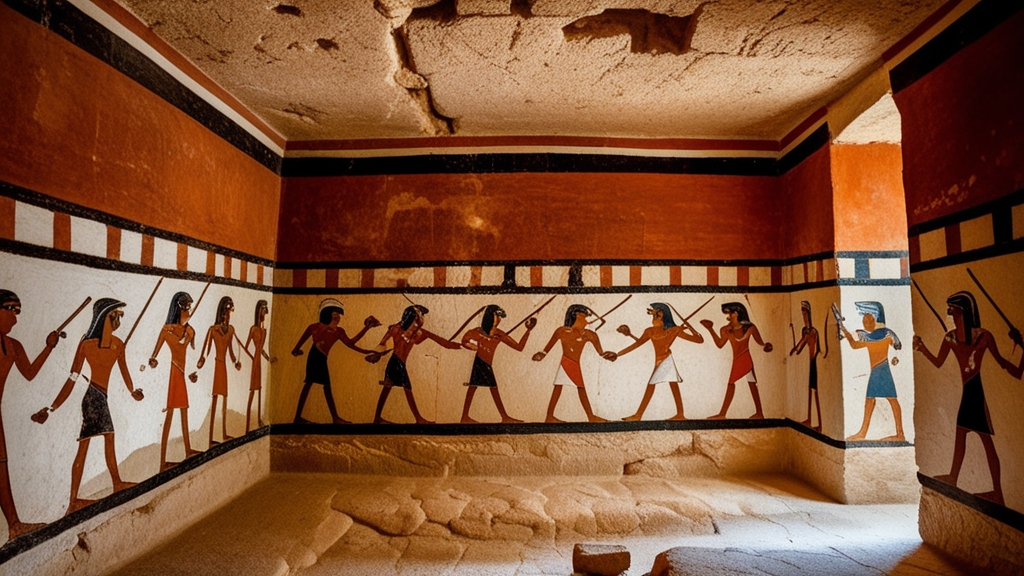
This is the section most military history sources skip entirely — and for a site like Artful Martial, it's arguably the most interesting thread in the whole story.
Wrestling and Stick-Fighting: Egypt's Indigenous Combat Sports
The tomb complex at Beni Hasan, dating to roughly 2000 BCE (Middle Kingdom), contains one of the most extraordinary documents in martial arts history: a series of painted scenes depicting hundreds of wrestling pairs in clearly sequential technique sequences. These aren't generic combat scenes — they show specific takedowns, joint locks, throws, and ground positions that any modern grappler would recognize immediately. Leg trips, hip throws, single-leg takedowns, and what looks unmistakably like a rear clinch with a hip toss. Four thousand years ago, someone painted the single-leg and the hip toss onto a tomb wall. The fundamentals don't change.
Tahtib (taḥṭīb) is the Egyptian stick-fighting tradition that survives to this day. Practiced with a roughly 1.2-meter wooden staff, it appears in ancient tomb art and has been continuously practiced in Upper Egypt as both a martial art and a ceremonial dance form. UNESCO recognized tahtib in 2016 as part of Egypt's intangible cultural heritage. It's one of the oldest documented combat traditions still practiced by living human beings — and it's largely absent from mainstream martial arts discourse.
Military Training Methods and Physical Conditioning
Egyptian sources describe young soldiers undergoing systematic physical training: running, wrestling, weapons drill, and swimming. The pharaoh himself was expected to demonstrate physical prowess — Amenhotep II is described in inscriptions as an exceptional archer who could shoot through copper targets from a moving chariot, a feat that, even allowing for royal exaggeration, implies genuine and rigorous athletic conditioning.
Conscripts received weapons training in organized camps before campaigns. Professional soldiers trained continuously. The emphasis on archery, wrestling, and chariot driving as the three core military skills shaped what Egyptian physical culture valued in a fighting man: ranged accuracy, close-grappling capability, and the coordination to function on a moving vehicle platform.
How Egyptian Combat Arts Influenced Neighboring Cultures
Egypt's military reach during the New Kingdom spread its combat practices across the Levant and into Nubia. Egyptian garrison troops stationed in Canaan, Cyprus, and Nubia interacted with local populations for generations. The khepesh sword spread from Egypt into Canaanite warrior culture. Egyptian archery technique influenced Nubian practice and vice versa in a genuine two-way exchange. The Medjay, originally Nubian desert scouts employed by Egypt, eventually became synonymous with the Egyptian police institution — their name (mḏȝ) becoming a generic term for law enforcement officer in Egyptian texts.
The movement of combat knowledge in the ancient Mediterranean wasn't a one-way broadcast from a single source. It was a messy, continuous exchange driven by mercenary service, conquest, diplomacy, and simple proximity. Egyptian combat history is inseparable from that broader web.
What Egyptian Combat History Still Teaches Us
Egyptian combat history rewards close study precisely because it refuses to fit a simple narrative. This wasn't a static civilization grinding out the same tactics for three thousand years. Egypt adapted — sometimes brilliantly, sometimes too slowly — to the Hyksos chariot, the Hittite heavy infantry, the Sea Peoples' amphibious raids, the Mamluk cavalry revolution, and eventually the mechanized warfare of the twentieth century. The thread running through all of it is a recurring willingness to absorb foreign military technology and make it Egyptian.
The Beni Hasan wrestling scenes remind us that organized unarmed combat is at least four thousand years old in the Nile Valley. Tahtib is still being practiced in Upper Egyptian villages today. The Mamluk furūsiyya tradition produced cavalry warriors that stopped the Mongols. The soldiers who held the line at El Alamein fought on the same ground where Ramesses once carved his victories into stone.
For anyone studying the martial arts — ancient or modern — Egyptian combat history offers something rare: a continuous record long enough to watch how fighting systems actually evolve under pressure. Not the clean origin myths we prefer but the messy, cross-cultural, pragmatic reality of people figuring out how to survive a fight. That's worth knowing.
Explore more on related topics — ancient Near Eastern warfare, the Mamluk martial tradition, and the history of wrestling — across Artful Martial.
Frequently Asked Questions
FAQ
What weapons did ancient Egyptian soldiers use in battle?
Egyptian soldiers carried composite bows, thrusting spears, battle axes, maces, daggers, and — for officers and elite infantry — the curved khepesh sickle-sword. The composite bow was the most tactically important weapon of the New Kingdom period, particularly when used from chariot platforms. The khepesh, often associated with Egyptian iconography, was actually derived from a Canaanite weapon form adopted during the New Kingdom.
How was the ancient Egyptian army organized and ranked?
By the New Kingdom, the Egyptian army was organized into divisions of roughly 5,000 men each, named after major deities — Amun, Ra, Ptah, and Set were the four divisions at Kadesh. Each division combined chariotry and infantry. Below division level, units broke down into companies of around 200 men, platoons of 50, and ten-man squads. Command ran from the pharaoh as supreme commander down through generals, standard-bearers, and squad leaders.
What role did Egypt play in World War II combat?
Egypt was the primary theater of the Western Desert Campaign (1940–1943), with the battles of El Alamein fought on Egyptian soil roughly 100 kilometers west of Alexandria. The First Battle halted Rommel's Afrika Korps in July 1942 and the Second Battle in October–November 1942 under Montgomery drove Axis forces into permanent retreat from North Africa. Egypt's ports, railways, and infrastructure were essential to Allied logistics throughout the campaign.
Did ancient Egyptians practice any form of unarmed combat or martial arts?
Yes. The tomb paintings at Beni Hasan (c. 2000 BCE) depict hundreds of wrestling pairs in sequential technique sequences showing throws, takedowns, and ground positions recognizable to any modern grappler. Tahtib, a staff-fighting tradition, appears in ancient Egyptian art and is still practiced in Upper Egypt today — UNESCO recognized it as intangible cultural heritage in 2016. Military training also included systematic wrestling and physical conditioning.
How did the Hyksos invasion change Egyptian military technology?
The Hyksos occupation of the Nile Delta (c. 1650–1550 BCE) introduced Egypt to the horse-drawn war chariot, the composite bow, and improved bronze weapons — all technologies Egypt lacked before the invasion. When the Theban kings expelled the Hyksos under Ahmose I around 1550 BCE, they adopted all three innovations and built the New Kingdom military machine around them, particularly the chariot corps that became central to Egyptian battlefield doctrine.
What was daily life like for an ancient Egyptian soldier on campaign?
Campaign life was physically demanding. Soldiers carried weapons, water skins, and rations of bread and dried fish on long marches through desert terrain. Egyptian texts, including the satirical Papyrus Anastasi I, describe blisters, bad water, mountain ambushes, and disease as constant hazards. On the positive side, successful campaigns brought plunder — shares of cattle, slaves, and precious metals — and exceptional soldiers could receive the Gold of Valor, gold pendants awarded personally by the pharaoh for battlefield distinction.