
Polynesian Stick Fighting: Weapons, Techniques, and the Warriors Behind Them

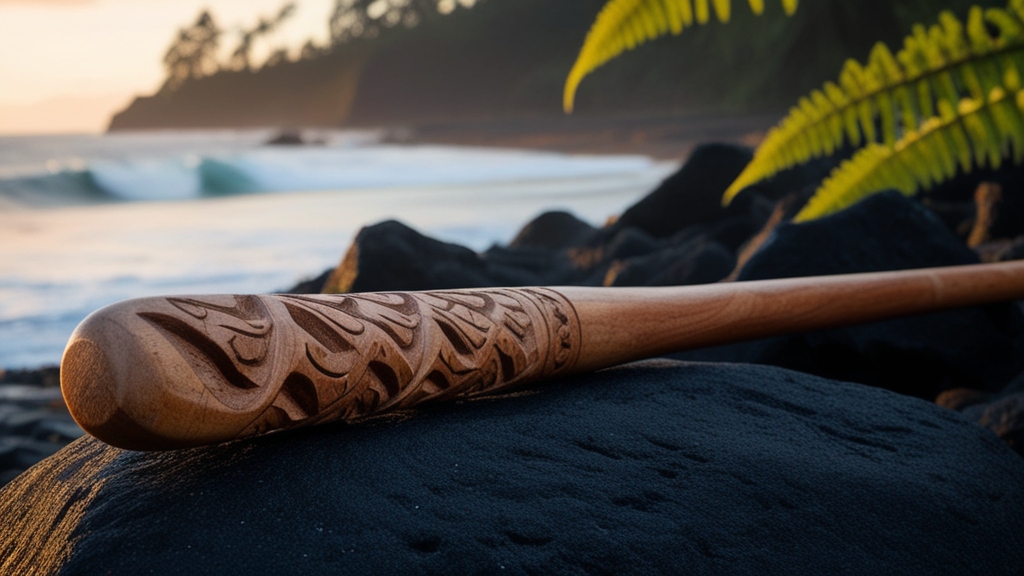
Here's a question most martial artists never ask: what were warriors doing on the deck of a war canoe, miles from shore, when the fighting started? They weren't throwing kicks. They were working with weapons — staffs, clubs, and bone-inlaid blades shaped by island ecology and centuries of inter-tribal conflict. Polynesian stick fighting is one of the least documented and most underestimated weapon traditions on earth and it evolved almost entirely in isolation from the Asian martial arts that dominate the conversation today. The Polynesian Triangle — stretching from Hawaii in the north to Easter Island in the east and Aotearoa (New Zealand) in the southwest — produced fighting systems that are tactically sophisticated, culturally layered, and very much alive. This guide covers the weapons, the mechanics, the history, and the practical path forward for anyone serious about exploring these arts.
- Before the Gym, There Was the Marae: A Living Tradition
- The Taiaha: Māori Polynesian Stick Fighting From First Principles
- Beyond the Taiaha: Other Polynesian Stick Fighting Weapons
- The Polynesian Fighting Style: How Polynesian Stick Fighting Fits Into a Broader System
- Ceremonial Combat and the Ritual Life of the Warrior
- From the Pacific to the Mainland: How Polynesian Stick Arts Traveled
- Learning Polynesian Stick Fighting: What Beginners Actually Need to Know
- The Tradition Isn't Dead — It's Evolving
- FAQ
Before the Gym, There Was the Marae: A Living Tradition
Picture a marae — the sacred communal ground at the heart of a Polynesian village. Not a training hall, not a gym. A place where the political, spiritual, and martial lives of a community converged. Warriors trained here. Disputes were settled here. And the skills they sharpened — footwork, weapon handling, reading an opponent's weight — were not recreational. They were survival infrastructure.
The Pacific Ocean is the largest single body of water on the planet and the islands scattered across it were home to tribal cultures that developed some of the most effective war arts ever conceived. Crucially, as the WAMA Club's research on Pacific fighting arts notes, many of these systems evolved in a vacuum, untouched by the cross-pollinating influences that shaped Asian martial arts for centuries. That isolation produced something rare: original tactical thinking.
Why Polynesian Stick Fighting Still Matters Today
Cultural reclamation is the most urgent reason. In Aotearoa, Hawaii, Samoa, and Tonga, indigenous communities are actively rebuilding martial knowledge that colonization nearly erased. For practitioners, these arts offer a complete system — weapon work, empty-hand combat, grappling, and a ceremonial framework that keeps you accountable to something larger than sport. For martial artists from outside these cultures, they represent a genuinely different problem-solving approach to range, timing, and multiple-attacker scenarios.
They're also, frankly, fascinating to train. The weapon geometries are unlike anything in European or East Asian systems.
The Geography That Shaped Island Combat
Island warfare has specific constraints. Terrain is broken — volcanic rock, dense jungle, narrow coastal strips. Engagements happen at close to mid-range. Retreat often means water. These realities pushed Polynesian weapon design toward tools that were effective in tight spaces, durable in humid climates, and lethal at the ranges where island combat actually happened. Hardwoods like kauila (Hawaiian ironwood) and manuka (New Zealand tea tree) became the raw material of choice. Where wood was scarce or insufficient, bone and obsidian filled the gap. Every material choice was an ecological decision.
The Taiaha: Māori Polynesian Stick Fighting From First Principles
If you ask most people what a Māori fighting staff is called, you'll get a blank stare or a confident wrong answer. The correct answer is the taiaha — a five-to-six-foot weapon that is arguably the most technically sophisticated single arm in the entire Polynesian arsenal. It's not a simple club. It's a dual-ended instrument that functions as both a thrusting weapon and a striking one and training with it properly takes years.
Anatomy of the Taiaha — Parts, Materials, and Dimensions
The taiaha has three named sections:
- Arero (tongue): the flat, tongue-shaped blade at the striking end, used for thrusting and hooking
- Tinana (body): the long central shaft, gripped during combat and used for parrying
- Rau (leaf/blade): the upper carved section near the arero, which can deliver slashing strikes
Traditional taiaha were carved from a single piece of hardwood — most commonly manuka or maire — and finished to a smooth, dense surface that could absorb the impact of weapon-on-weapon contact. Length typically runs between 150 and 180 centimeters. The weapon is heavier toward the arero end, which affects balance during thrusts and forces the practitioner to manage momentum deliberately rather than just swinging and hoping.
Core Taiaha Techniques: Footwork, Guards, and Strikes
The fighting mechanics of the taiaha are built around triangular footwork. You don't stand square. Weight distributes between a forward and rear foot at roughly a 40/60 split, with the hips angled to present a narrower target profile. From this base, the practitioner can:
- Thrust with the arero — a linear drive from the rear hip, similar mechanically to a spear thrust but with the flat blade angled to penetrate guard
- Sweep and hook — using the arero's flat shape to redirect an incoming weapon or trap a limb
- Strike with the tinana — a mid-shaft strike delivered with rotation from the core, not just the arms
- Parry and counter — blocking with the tinana while simultaneously positioning the arero for a follow-up thrust
Breath is not incidental. Exhalation on the strike, controlled inhalation during footwork transitions — the same principle you find in good karate or Muay Thai, applied to a weapon system.
How Taiaha Training Is Structured Today
In contemporary Aotearoa, taiaha instruction often happens within kapa haka (Māori performing arts) groups and dedicated martial arts clubs. Training begins with solo forms — learning the weapon's weight and balance before a partner enters the picture. Partner work introduces controlled sparring with padded or wooden practice weapons. Senior practitioners in established lineages are emphatic that the taiaha cannot be separated from the cultural context of tikanga Māori (Māori protocol and custom). You're not just learning a weapon. You're entering a relationship with a tradition.
Beyond the Taiaha: Other Polynesian Stick Fighting Weapons
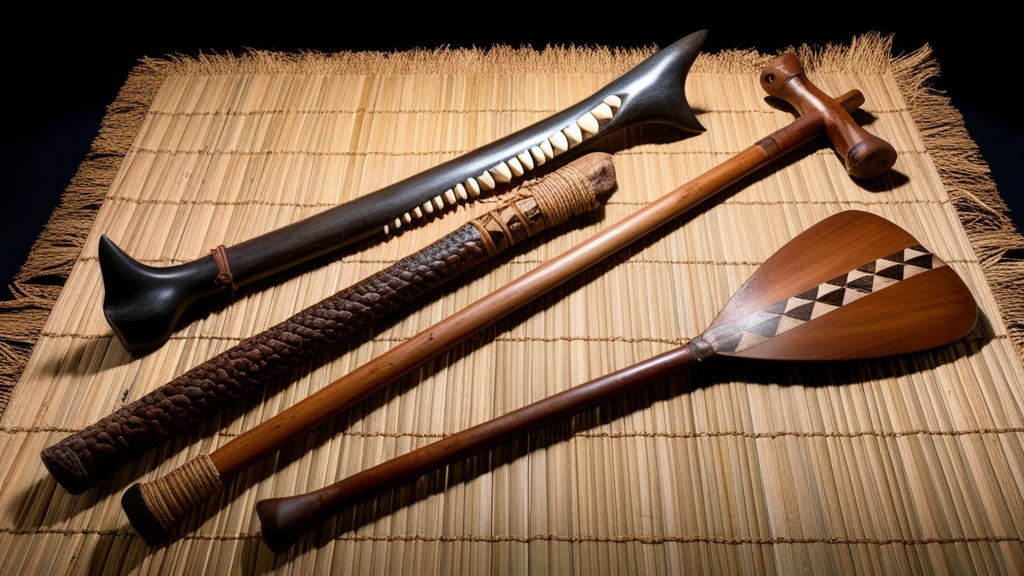
The taiaha gets most of the attention but it's one instrument in a much larger orchestra. Across the Polynesian Triangle, weapon traditions varied dramatically based on available materials, inter-island trade, and the specific tactical problems each culture faced.
Hawaiian Weapons — Pāhoa, Leiomano, and the Kauila Staff
Hawaiian martial culture produced a distinct weapons vocabulary:
- Pāhoa: a short dagger, often made from hardwood or bone, used in close-quarters combat
- Leiomano: a club edged with shark teeth set into a wooden base — a weapon that functions like a saw at close range
- Kauila staff: a long striking weapon made from kauila wood, one of the densest hardwoods in the Hawaiian Islands
The kauila staff shares functional territory with the taiaha but differs in construction and striking geometry. Where the taiaha has a shaped arero for thrusting, the kauila staff is more uniform — a pure striking and blocking tool. The shark-tooth leiomano, meanwhile, belongs to a weapon category unique to Pacific cultures: a composite tool that combines the reach of a club with the cutting edge of an obsidian or bone blade. Elegant and brutal at the same time.
Samoan and Tongan Fighting Implements
Samoan warriors used the to'oto'o — a ceremonial and martial staff — alongside short clubs and spears. Tongan weapon culture emphasized the apa'apai, a paddle-shaped club, and various forms of throwing weapons. Both traditions share a design philosophy: weapons that work at multiple ranges, transitioning from throwing to striking to grappling without requiring the warrior to change tools.
| Feature | Māori (NZ) | Hawaiian | Samoan/Tongan |
|---|---|---|---|
| Primary long weapon | Taiaha (staff) | Kauila staff | To'oto'o (staff) |
| Close-range weapon | Mere (short club) | Pāhoa (dagger) | Short clubs |
| Unique material feature | Carved hardwood | Shark-tooth inlay | Whale bone elements |
| Dual-range design | Yes | Yes | Yes |
The through-line is adaptability. Every system built weapons that could handle the unpredictability of island combat — changing terrain, multiple opponents, and the need to shift from long-range to grappling range in seconds.
The Polynesian Fighting Style: How Polynesian Stick Fighting Fits Into a Broader System
Asking "what is the Polynesian fighting style?" is a bit like asking what European martial arts look like — the answer is plural. But there are structural commonalities worth naming and two systems in particular illuminate how stick fighting sits inside a larger tactical framework.
Lua — The Hawaiian Art of Bone-Breaking and Its Weapon Component
Lua is the traditional Hawaiian martial art and its name translates roughly to "pit" or "hole" — a reference to the joint manipulation and bone-breaking techniques at its core. Lua is a complete system: strikes, throws, joint locks, and weapon work all belong to the same curriculum. The weapon component includes the kauila staff, the pāhoa, and the leiomano. What distinguishes Lua's weapon integration is that weapon and empty-hand techniques share the same underlying body mechanics. The hip rotation that drives a Lua strike is the same rotation that powers a staff thrust. The system doesn't compartmentalize.
Lua nearly disappeared under colonial suppression — practiced covertly for much of the 19th and early 20th centuries, passed between trusted hands rather than taught openly. Revitalization efforts, particularly through Hawaiian cultural organizations, have brought it back into structured instruction.
Limalama — A Synthesis of 13 Polynesian Arts
Limalama ("touch of the master's hand" in Samoan) is a composite system drawing from thirteen Polynesian martial traditions. Founded by Tino Tuiolosega in the 20th century, Limalama synthesizes weapon work, empty-hand striking, and grappling from across the Pacific. It's one of the few formal systems that explicitly names its Polynesian sources and attempts to preserve their distinct characteristics within a unified curriculum.
Multiple-Attacker Philosophy and Why It Shaped Weapon Use
Island warfare was rarely a clean one-on-one affair. Raids involved groups. Defense required handling multiple threats simultaneously. This reality baked a specific philosophy into Polynesian weapon design and footwork: never commit so deeply to one opponent that you lose awareness of the others. The circular footwork patterns in taiaha training, the sweeping strikes that create space rather than just targeting a single body, the preference for weapons with multiple functional ends — all of it reflects a tactical environment where the fight was almost never just between two people.
Ceremonial Combat and the Ritual Life of the Warrior
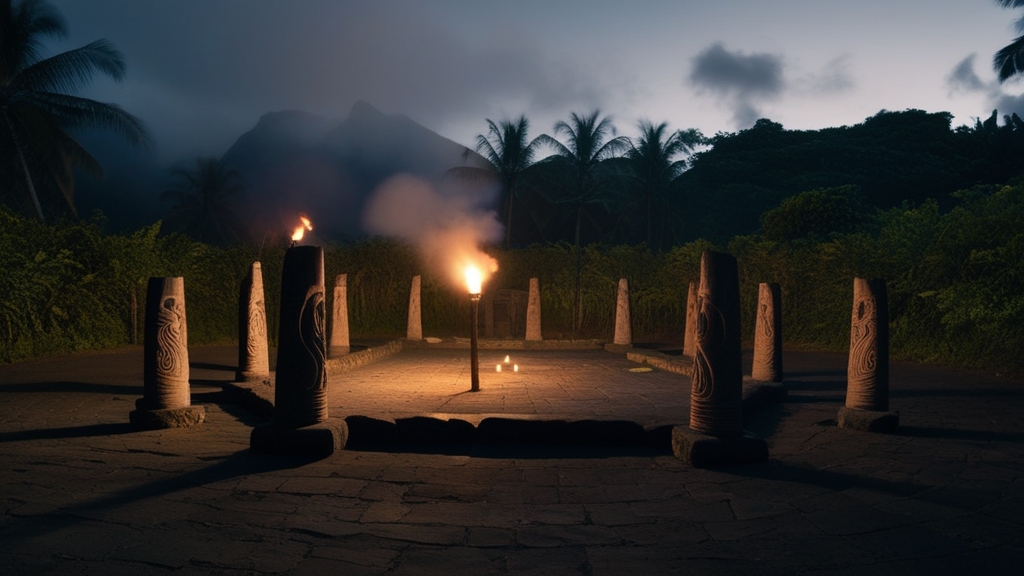
Separating the martial from the ceremonial in Polynesian culture is a category error. The two were never separate to begin with.
Stick Fighting in Ceremony, Funeral Rites, and Status Display
Weapon displays at the marae served social functions inseparable from their martial ones. A warrior's skill with the taiaha communicated rank, readiness, and the health of his lineage's fighting knowledge — all at once, in public, with an audience that knew exactly what it was watching. Funeral rites for high-status warriors often included weapon demonstrations — a way of honoring the dead and signaling to rivals that the community's fighting capacity remained intact. Traditional Polynesian sports and competitions, including formalized stick-fighting contests, were mechanisms for status negotiation between groups who might otherwise be at war.
The Haka and Pre-Combat Ritual as Tactical Preparation
The haka is widely known as a Māori war dance but that framing undersells its function. Before combat, the haka served as genuine physiological preparation: controlled breathing, rhythmic movement, and collective vocalization that synchronized a group's nervous systems and elevated arousal to combat-ready levels. The stamping, the tongue protrusion, the eye-widening — these are not theatrical choices. They're the outputs of a system designed to transition the body from rest to high-intensity action while simultaneously presenting a psychologically destabilizing display to the enemy. It's pre-fight preparation wearing ceremonial clothes.
From the Pacific to the Mainland: How Polynesian Stick Arts Traveled
Polynesian martial arts didn't stay on the islands. They traveled with the people — through immigration, through military service, and through the cultural mixing that happened in Hawaii's uniquely cosmopolitan early 20th-century fighting scene.
Hawaiian Immigration and the Spread of Island Martial Arts
Hawaii functioned as a crossroads. Japanese, Chinese, Filipino, Korean, and Polynesian communities all lived in proximity and their martial cultures inevitably mixed. Hawaiian practitioners of Lua and related arts trained alongside practitioners of Japanese judo, Filipino Kali, and Chinese kung fu. The result was a martial culture that was syncretic by nature — absorbing and adapting without losing its Pacific core.
Kajukenbo, Kenpo, and the Polynesian Stick Fighting DNA Inside American Martial Arts
Kajukenbo — the name is a portmanteau of Karate, Judo/Jujitsu, Kenpo, and Boxing — was founded in 1947 in the Palama Settlement neighborhood of Honolulu. Its founders included Sijo Adriano Emperado, Peter Choo, Frank Ordonez, Joe Holck, and Clarence Chang. The system was built explicitly for street survival in a tough urban environment and it drew on the fighting knowledge available in that specific Hawaiian context — which included Polynesian grappling and weapon concepts alongside its more widely credited Asian influences.
Kenpo lineages that trace through Hawaii carry similar cross-pollination. The stick-fighting contributions are harder to document precisely — the transmission was often informal — but the footwork patterns, the multi-range weapon philosophy, and the emphasis on practical application over sport competition all bear Polynesian fingerprints. For a deeper look at Kajukenbo's documented history, the Kajukenbo Self Defense Institute maintains lineage records.
Learning Polynesian Stick Fighting: What Beginners Actually Need to Know
No competitor content addresses the beginner angle seriously. That's a gap worth filling directly.
Finding Authentic Instruction — What to Look For and What to Avoid
Authentic instruction in Polynesian stick fighting is not abundant but it exists. Here's what to look for:
- Cultural connection: Legitimate schools acknowledge the cultural origin of what they teach. If an instructor presents these arts without any reference to Māori, Hawaiian, Samoan, or Tongan cultural context, be skeptical.
- Lineage transparency: Can the instructor name their teachers? Can those teachers be verified through community organizations or cultural bodies?
- Technical specificity: A good instructor can explain why a technique works — the body mechanics, not just the movement pattern.
Avoid schools that market these arts as "exotic" or use language like "ancient secrets." That's cultural tourism dressed as instruction and it's a disservice to the traditions themselves.
For those searching for Polynesian stick fighting near you, start with Hawaiian cultural centers, Māori community organizations (in areas with significant New Zealand diaspora populations), and Pacific Islander community groups. Many legitimate instructors teach within community contexts rather than commercial gyms.
Foundational Drills and the First Skills to Build
Before you pick up a taiaha, build these foundations:
- Grip strength and wrist flexibility — weapon work demands both; start with basic grip exercises and wrist rotations
- Triangular footwork — practice moving in triangle patterns without a weapon, keeping your weight centered and your hips mobile
- Single-end strikes — learn to generate power from the hips before adding the complexity of a dual-ended weapon
- Basic parrying mechanics — use a short stick or dowel to practice redirecting force rather than absorbing it
The learning curve is real but not steep if you approach it systematically. Most practitioners with a background in any weapon art — Filipino Kali, Japanese bojutsu, even European staff work — find the underlying mechanics familiar even when the specific techniques are new.
Equipment, Safety, and Training Partners
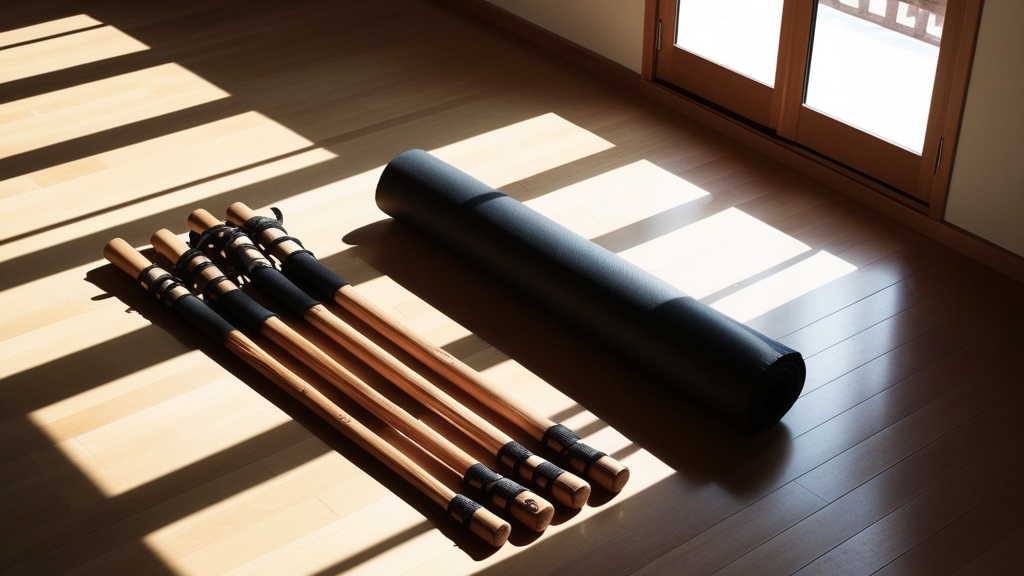
For beginners, a rattan practice staff (similar to what Arnis/Kali/Eskrima practitioners use) works well as a stand-in for a taiaha until you find purpose-made training weapons. Rattan absorbs impact, won't shatter, and is cheap enough that you won't wince when it takes a beating. Pair it with:
- Forearm guards — the most common contact point in weapon sparring
- A willing training partner who understands controlled pressure
- Eye protection for any live sparring at speed
Don't rush into free sparring. Structured partner drills — feeding attacks at controlled speed and having your partner parry and counter — build the reflexes and spatial awareness that sparring requires.
The Tradition Isn't Dead — It's Evolving
Polynesian stick fighting and the broader constellation of Pacific martial arts are in active revival. In Aotearoa, taiaha instruction is part of te reo Māori (Māori language) and cultural programs at schools and universities. In Hawaii, Lua practitioners are documenting lineages and building structured curricula. Samoan and Tongan communities in New Zealand, Australia, and the United States are establishing clubs that teach traditional weapon arts alongside modern combat sports.
Modern Practitioners and Cultural Revitalization Efforts
The most significant development is institutional support. Universities in New Zealand have begun incorporating taiaha and related arts into indigenous studies programs. Cultural organizations in Hawaii are formally training instructors in Lua to ensure the art survives beyond individual practitioners. These aren't hobbyist efforts — they're systematic responses to the near-loss of living martial knowledge under colonization.
For martial artists outside these communities, the appropriate posture is respectful engagement. Attend open cultural events. Support indigenous-led instruction. Don't extract techniques from their context and repackage them.
Frequently Asked Questions About Polynesian Stick Fighting
See the FAQ section below for answers to the most common questions about these arts — including pronunciation, comparisons to Filipino Kali, and whether Soryu is a real fighting style.
FAQ
What is a Māori fighting stick called?
The primary Māori fighting staff is called the **taiaha**. It's a five-to-six-foot hardwood weapon with a carved tongue-shaped blade (arero) at one end and a flat striking blade (rau) near the top. Pronounce it roughly as 'tie-ah-ha' — three syllables, with the stress on the first. It's a dual-ended weapon used for thrusting, sweeping, and parrying.
What is the Polynesian fighting style?
There's no single Polynesian fighting style — the tradition spans dozens of island cultures across the Polynesian Triangle. The most documented systems include Lua (Hawaiian, emphasizing bone-breaking and joint manipulation with weapon integration) and Limalama (a synthesis of thirteen Polynesian arts founded by Tino Tuiolosega). What these systems share is a multi-range weapon philosophy, circular footwork, and a design built for multiple-attacker scenarios.
What is Filipino stick fighting called?
Filipino stick fighting goes by three names depending on region and lineage: **Arnis** (the national martial art of the Philippines), **Kali** (often used in the West and associated with older Visayan traditions), and **Eskrima** or **Escrima** (common in the Visayas). All three refer to overlapping weapon-based systems emphasizing single and double stick, blade, and empty-hand combat. They're related to Polynesian weapon arts through Pacific trade routes but developed as distinct systems.
Is Soryu a real fighting style?
Soryu appears in fictional contexts — most prominently in video games and media — as a stylized Polynesian or Pacific martial art. It is not a documented historical or living martial tradition. No credible source in the martial arts research community lists Soryu as an established system with verifiable lineage or practitioners.
Can beginners learn Polynesian stick fighting, and where do you start?
Yes, beginners can learn these arts — but authentic instruction is the critical first step. Look for instructors connected to Hawaiian, Māori, Samoan, or Tongan cultural organizations rather than commercial gyms marketing 'exotic' content. Start by building grip strength, triangular footwork, and basic parrying mechanics before picking up a full-length weapon. A rattan practice staff is a safe, affordable training tool while you find purpose-built equipment.
How is Polynesian stick fighting different from Filipino Kali or Eskrima?
The core difference is design philosophy and cultural context. Filipino Kali/Eskrima developed in a Southeast Asian archipelago with extensive cross-cultural contact — it shows in its blade-heavy curriculum and its sophisticated single-stick/double-stick framework. Polynesian stick fighting evolved in greater isolation, producing weapons like the taiaha that function as dual-ended thrusting and striking tools, and systems built around the specific tactical realities of island warfare including multiple-attacker defense. The footwork geometries and weapon-to-body integration also differ significantly between the two traditions.